
It’s Not Just About the Price
If you’re a business leader looking for consulting support, you’ve probably noticed the huge price gap between large firms and independent consultants. Yet price is only the visible part of the story. In reality, the real difference lies in incentives — and this is exactly where independents have a clear structural advantage.
Big firms are not owned by “Big Corpo”
First, let’s clear up a very common myth. Deloitte, McKinsey, PwC, EY, KPMG, or Gallup are not owned by large corporate groups, banks, private equity funds, or tech giants.
In fact :
- Deloitte, PwC, EY, and KPMG are global networks owned by their local partners.
- McKinsey remains a private partnership fully owned by its senior directors.
- Gallup is owned by its employees.
As a result, the real capital owners are the partners themselves. Profits flow directly back to them. Consequently, every project decision quietly passes through one single question: “Will this grow the firm’s revenue and our personal payouts?”
Why big firms always end up selling you much more than just advice

Because partners earn more when the firm grows, these companies have built entire ecosystems around their recommendations. Moreover, they have created:
- Dedicated implementation teams that only make real money when clients buy and install specific software platforms.
- Strategic alliances with major vendors (SAP, Oracle, Microsoft, Salesforce…) that generate commissions or preferred-partner deals.
- Investment arms or financial vehicles for the partners (such as Deloitte Ventures or the former MIO Partners at McKinsey) that sometimes create subtle conflicts of interest.
The result? Consultants often quietly turn a €200k strategy project into a €5M–€10M “full transformation”… simply because that’s where the big follow-on fees are. By the way, the consultants are not malicious — they are simply following the incentives built into their business model.
Independent consultants have NONE of these incentives
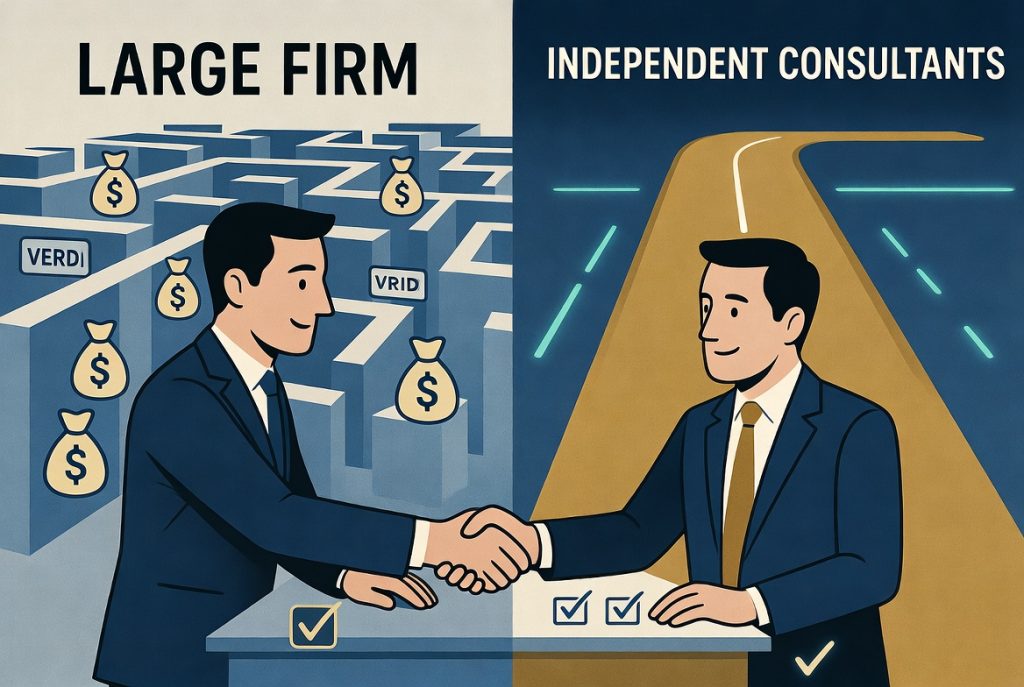
When you work with a true independent consultant, everything changes:
- There is no implementation army to feed.
- There are no commission deals with software vendors.
- There is no partner equity that profits from upselling suites or platforms.
- There are no venture stakes that create subconscious bias.
Consequently, we only get paid for the advice and the concrete results. So if a free solution, a low-cost tool, a simple process tweak, or an open-source option solves your problem, that’s exactly what we will recommend — because we have no financial reason to complicate things.
And today: the misuse of AI by large firms
But that's not all. For the past few years, major firms have added a new weapon to their arsenal: AI. They use it extensively… but not in the way you might think.
They load millions of customer data points (conversations, strategies, files, models) into gigantic centralized databases to "train" their internal tools (like Lilli at McKinsey). The result? They sell a dream: "AI-generated" reports that seem ultra-intelligent... but which rely on data that is constantly stored.
And this has had consequences. Just 10 days ago (March 2026), an autonomous AI agent hacked McKinsey's Lilli platform in only 2 hours. It gained full read and write access and exposed:
- 46.5 million unencrypted customer messages
- 728,000 confidential files
- Thousands of strategies, mergers and acquisitions, and sensitive data

This is exactly what happens when you centralize everything in large databases to "gain efficiency" and resell AI solutions to customers.
Why an independent contractor is much better in this regard
I also use AI every day… but in a completely different way.
I do not store any permanent customer data anywhere. I do not have a central database. I do not train any models with your information.
I only use it as a personal and local tool:
- To follow the news in real time
- To help me write or structure a report
- To improve a visual or reformat a document
Concrete example: You give me a 40-page report. I can ask a local model to provide a clear summary or a new visualization in 3 minutes. But as soon as it's done, I delete everything. Nothing is saved. Your data stays with you and only with you.
It’s safer, more ethical, and above all aligned with your interests rather than with those of a large firm seeking to monetize your data.
The final result
Big firms are not “evil.” Yet they are structured to sell more and more. On the other hand, independents are structured to sell only what is truly necessary.
This single difference delivers real benefits: faster decisions, a much lower total cost of ownership, and above all, advice that is genuinely aligned with your objectives instead of growing someone else’s empire.
If you’re tired of being steered toward expensive “solutions” that mainly serve the firm’s P&L rather than your own business, an independent consultant might just be the objective and refreshing partner you’ve been looking for.
Ready to talk about your specific challenge — with zero hidden agenda? Just send me a message. I’m here to help, not to upsell.
Norbert Pardo
CEO & founder – Monad Edge